Friday, December 19, 2008

Silent Night


I have been promised an MP3 player as a Christmas present. I am eagerly anticipating the opportunity to listen to my favourite podcasts and music tracks. However, this prospect prompted me to consider how we do anything we can to avoid silence: 24 hour news coverage in my dentist's surgery, in-flight films, seasonal (albeit secular) songs on the supermarket tannoy, the noisy list goes on...

Silence is uncomfortable. In moments of quiet reflection, we are confronted with truths we would rather bury under decibels of noise. Yet it is often in the silent moments that God speaks to us, with His still small voice [1 Kings 19] [Dear Lord and Father of Mankind].

I'm no quaker, but the principle of silence in the presence of God is far more ancient than George Fox's Society of Friends. "Be still and know that I am God" [Psalm 46].

So, just as on the Stille Nacht of the first Christmas, the quiet shepherds received a message from heaven, I recommend we all spend some time in silence this Christmas, quietly waiting for the salvation of the Lord. As the shepherds discovered, we find salvation when we find the Saviour - Christ the Lord...

How silently, how silently
The wondrous gift is given
So God imparts to human hearts
The blessings of His heaven
No ear may hear His coming
But in this world of sin
Where meek souls will receive Him still
The dear Christ enters in.

Tuesday, November 18, 2008

Survival of the Unfittest


Darwin, Dawkins and Co advocate the principle of survival of the fittest. Whether or not we subscribe to this theory of natural selection, we must agree that it completely goes against the grain of human nature.

We do everything we can to promote the opposite effect - which here I call survival of the unfittest. Why else is there such outrage over species that are almost extinct? Only this week, there are reports of genome reconstruction for the woolly mammoth, long consigned to bio-history by natural selection.

Survival of the unfittest is most fiercely defended with regard to our fellow human beings. Equal opportunities effectively means positive discrimination in favour of the disadvantaged. How un-Darwinian this is! We instinctively seem to prefer Baron de Coubertin's "don't worry about winning, just take part" mentality that sees its ultimate fulfilment in the Paralympic Games.

I suggest that this compassionate equal-rights-for-all attitude springs from our "image-of-God" legacy. The Biblical creation record notes that God made man "in His image, after His likeness". Although sinful, miserable humanity little resembles the Divine Character, our equal opportunities movement is still "some feeble, pale reflection / of that pure love of Thine." [hymn]

Only God lifts beggars from rubbish tips and sets them among princes [1Sam2.8]. This is divine grace in action. He pays the price (in the sin-atoning death of Jesus Christ) to reconcile us to Himself. The price is paid for all, so the offer is available to all; even though none of us deserves it.

Friday, July 25, 2008

Spiritual Detox


Here's the problem: a Christian spends some time drifting away from his Lord and His Word. Apathy soon leads to active disobedience - and that Christian is suddenly in no fit condition to act effectively for God.


Here is one solution, which involves prayerfully reading through three detox chapters of the Bible.


  1. Jonah 2 - Penitence
  2. Psalm 67 - Passion
  3. John 21 - Pardon


Penitence is first. Genuine sorrow for wrong motive, direction and/or action. Plenty of Bible passages apply, but I prefer Jonah's heartfelt prayer. He knew his disaster was entirely due to his own disobedience, and His recovery could only be accomplished by God's grace.


Passion is next. An earnest longing for God's presence, power and glory. Psalm 67 clearly cries out for this. So should we, whenever we feel its loss!


Pardon is last. With Christ's death and resurrection in mind, we know that pardon is possible in John 21. With Peter's denial and subsequent restoration, we are assured that personal pardon is bestowed by the Man who calls us, walks with us and directs us.

Monday, May 12, 2008

Combatting the McGospel Message Tendancy


I see the McGospel as a poor Gospel substitute - cheap flavour and colour, but no real substance to the message. Fast food, convenient, plenty of feel-good factor but little Biblical basis.

I think the McGospel has three vital ingredients missing. Add these in, and the message will become much more wholesome! However it becomes correspondingly more unpalatable to people who do not believe the Gospel ... "This is a hard saying, who can bear to hear it?"

  1. Repentance
  2. Blood
  3. Hell

I know, each of these themes is unsavoury at first taste. Christians who would present the Gospel are so often tempted to gloss over these points so as to avoid alienating their sophisticated 21st century audiences. I regret to confess that I am more guilty than most.

So - let's tackle each ingredient one at a time. We want to uncover what they are, why they are so unpopular and yet why they are essential Gospel elements.


Repentance


The canonical example is Jesus' story of the Prodigal Son, cf Luke 15. The son spurns his father's home, wastes his inheritance and ends up lost, lonely and miserable. At his wit's end, he finally starts to think straight. He recognises how wrong he has been and is full of remorse for his faults. He thinks of his father, and decides to return to him. This is true repentance - sorrow for sin and a desire to express this to the Father personally. True repentance is always met with true forgiveness - that's a timeless truth.

Now we must consider why repentance is so unpopular in the McGospel generation. Basically, it involves bringing people to realise that they are wrong, mistaken, and far from God. Such revelation is untenable in this era of moral relativism and post-modernism. But this is God's way. It was the imperative of the first Gospel message (Acts 2), the first of Paul's two Ephesian footsteps ("repentance toward God and faith in our Lord Jesus Christ" - Acts 20).

Blood


Blood is live-supporting and life-saving. The Bible emphasizes this - "the life is in the blood" before any renaissance scientists like William Harvey published their (re) discoveries. The Biblical imagery of poured-out blood speaks of a life completely given in sacrifice. Christ's death brings us life, his blood brings us redemption - these are axioms of New Testament theology.

So why would people disdain such a notion today? They reject a Gospel message that presents the "precious blood of Christ" as a payment for sins (a self-propitiation on God's part, rather than appeasement from man). They reject Jesus' promise of a "new covanent in my blood which is shed for many" (a relationship with God in which all the responsibility is on his part). Blood sacrifice is deemed to be inappropriate, primitive and archaic.

God's standards remain uncompromised by regressions in human ethics and morality. Sin is always serious, in his book. Serious crime demands commensurate payment, and nothing has greater value than the life blood of his only Son. Ultimately, to refuse "redemption through his blood, forgiveness of sins according to the riches of his grace" is to accept full personal liability for sin against God - which brings us to the final point...

Hell


Remarkably, Jesus spoke more about the experience of hell than about heaven. Not because he had any pleasure in the contemplation of suffering, but rather because he wanted people to appreciate its stark and grim reality, and avoid it at all costs.

Today hell is ridiculed, if it ever surfaces as a discussion item at all.
How could a loving God send people to hell? God does not want anyone in hell - he would have all people to be saved. But a person who refuses God's terms and God's way effectively sentences himself to an eternity of hell.

To finish, think about this: Jesus suffered the infinite torture of hell, compressed into three hours of darkness as he was on the cross. I have accepted this personally, he is my substitute. He went through hell without me so he could be in heaven with me.

Monday, January 21, 2008

Me and You


Some people claim that Jesus' teachings are entirely egocentric. To a point, I can see what they mean. The conventional teacher explains a subject - some physical, philosophical, moral or spiritual aspect of the world around us. The teacher points his pupils to an object other than himself. But the Lord Jesus Christ was different. So often he would say "I am..." and make astonishing claims about Himself. The C.S. Lewis poached egg mad/bad/God argument is par for the course here.


However I would like to bring out a different point. In every case when the Lord Jesus made a personal claim, he always did it with a view to blessing others. When he said "I am the bread of life", He immediately offered Himself to those who were spiritually hungry and thirsty. When he said "I am the Way", he promised that those who came through Him would reach the Father. When he said "I am the Good Shepherd", he promised to give his life for those who would be his sheep.


Every supposedly egocentric teaching of the Messiah is really a "for me and thee" teaching. (ref) He explains something about himself, and then shows us how He can bless us. Is that egocentric? No, I would rather define it as his amazing grace!

Monday, December 10, 2007


Wise Men Still Seek Him


The magi were the academics of the ancient world. In many ways they exemplify good research practice.

First, they are looking for anomalous patterns in their astronomical observations. This is Oscar Wilde's 'modern intellect' that expects the unexpected, and won't let it drop till a suitable explanation is reached. So next consider their thorough literature search, which leads them to dig up Balaam's ancient prophecy from Numbers 24:17, and possibly Isaiah's words in Isaiah 60:1-5. Initial experiments and background reading now completed, they are prepared to stake their academic reputation, not to mention their undoubtedly meager research grant income, on a field-trip to an insignificant far-flung province of the Roman Empire.

After a long and arduous journey (which may have taken up to two years, by King Herod's calculations) they visit the palace. Initially this looks like being a red herring, until they attend the local university seminar series to discover a previously unknown citation (Micah 5:2).

And so to Bethlehem. At last they reach their objective
'Finding the place; it was (you may say) satisfactory.' [T.S. Eliot]


The point of this article is, perhaps a little wryly, to show that the educated elite came to find the baby of Bethlehem. They were just as keen as hoi polloi. They put aside their uncertainty and prejudice, and were rewarded beyond measure. I issue a plea to fellow academics of all disciplines: Will you make a similar journey of discovery this Christmas?

Sunday, October 21, 2007

Positive Thinking


I recently discovered the positive atheism website, which is quite fascinating. Apart from several intemperate warnings against religious evangelists and apologists, it contains interesting viewpoints and quotations from leading atheist thinkers past and present.

The fundamental atheist tenet is "eat, drink and be merry, for tomorrow we die," as the stereotypical rich fool says in Jesus' story. This is an ego-centric viewpoint. There seems to be little positive sentiment here!

A more noble thought is expressed in an alternative maxim - "non sibi sed omnibus" - not for self but for all. The "love your neighbour" principle is common to all major world faiths. It also crops up in many politico-philosophical systems from communism to humanism.

So, what does a positive Christian have to offer in reply? The most positive Christian I can think of is the apostle Paul. And his most positive statement is "emoi gar to zeen christos kai to apothanein kerdos." Loosely translated: As far as I'm concerned, living is all about Christ, and dying is even better.

Is this life's ideal? A purpose for the present and a hope for the future? A positive Christian attitude, for sure...

Sunday, September 09, 2007

A Christian Opinion of Harry Potter


Pottermania swept across the county again this summer, with the release of the final book in the series. I confess that I have not read The Deathly Hallows as of yet, but I have enjoyed J.K. Rowling's earlier six novels.

Does the Harry Potter series glorify witchcraft? Does it promote anti-Christian values? Does it ...

Balance is essential in assessing such material. Consider two extreme approaches from New Testament times. First at Athens in Acts 17, Paul is heard to quote from two Greek poets, Epimedides and Aratus. So the exemplary convert to Christianity recycles pagan poetry in his sermons, when he feels it might be appropriate. Second at Ephesus in Acts 19, Paul's message leads the former wizards and witches to burn their spell books. This is testimony to all that their new-found faith in Christ is a life-changing experience.

So, what of pagan books? Quote them, or burn them? I should say the distinction lies in whether such books can be classified as literature or genuine evil. What of Harry Potter then? I think J.K. Rowling's genre must be somewhere between Athenian Poetry and Ephesian Black Magic. Therefore every Christian has to make an individual and intelligent choice about the matter. Also, I do not consider it right for me to criticise anyone else's choice. Finally the teaching of 1 Corinthians 10 and Romans 14 means that I should not let my decision cause offence to a fellow Christian in any way.

Tuesday, July 03, 2007

the mystery of life


Every day when I walk into work, I go past a red post box upon which someone has scrawled the word meaningless in large letters. I doubt this is the graffiti artist's impression of the Great British Postal Service. I rather interpret it to be his concise impression of life itself. Alas! How post-modern, post-Darwin, post-Dawkins philosophies have robbed us of a sense of purpose, whether individually or globally or on any intermediate scale.

So is life meaningless? It certainly seems to be so, at times. Even the greatest ancient intellect came to this conclusion (see Ecclesiastes chapter 1, for instance). However I would contend that life may often appear to be meaningless, because it is always puzzling. I know plenty of contemporary Christian teaching follows this line of argument ... God is the missing peace in your life's jigsaw puzzle. Nicky Gumbel et al(pha!) present this most eloquently. Another scheme (local to Manchester) is the Riddle of Life.

But I want to turn this allegory upside-down. God is not just the "missing piece" or even "missing peace" in your life's jigsaw puzzle. Rather, you are a missing piece in his intricate celestial puzzle. This seems more consistent with Jesus' presentation in Luke 15 - his lost sheep, lost coin, lost son trilogy of stories.

Of course, the fact that God has personally come to find us (through his Son) does not absolve us of the responsibility of searching for Him. This is precisely the message Paul presented to the pre-modern, pre-Darwin, pre-Dawkins society of Athens (Acts 17).

Which brings me neatly to my final point. Let me share with you one of my favourite Bible verses. It is a promise from Almighty God Himself, in Jeremiah 29.13 - "You will seek me and find me when you seek me with all your heart."

Friday, April 20, 2007

Today


The Today programme on BBC Radio 4 grills politicians, academics, lawyers et al on a daily basis. The intimidating presenters never seem to be lost for words! As each specialist arrives, the presenters greet them with a barrage of insightful questions.

It reminds me of the scene in Matthew 22. The Lord Jesus is in Jerusalem, his Messianic credentials are being examined closely by the authorities. Three different groups of people ask him "old chestnut" questions, to which they are sure there cannot be right answers ... and the Messiah confounds them all!

First up, the political question. "Should we pay taxes to Caesar?" What an issue to raise in Jerusalem, hotbed of Jewish fundamentalism and yet centre of occupying Roman administration! He would have to offend someone, whether he answered yes or no. So what did He reply? "Give Caesar what belongs to him. Give God what belongs to Him." Wow! That's more than playing with a straight bat! That's knocking the hapless interrogators for six!

Second, the hypothetical question. Rather more academic. "If a woman is widowed seven times, after marrying seven brothers one-at-a-time, who will she be married to in the resurrection?" (Questioner almost falls over laughing ... how ridiculous to consider the resurrection to be anything more than metaphorical!) The sniggers soon stop. The Messiah sternly points out that God describes Himself as "I am the God of Abraham," 400 years after Abraham's death. Abraham lives! God is the God of the living! Not the dead! Resurrection is literal. Life is eternal. Marriage is only temporary, unnecessary in heaven.

Third, the legal question. "Which is the greatest of God's laws?" asks an earnest lawyer. "Love God," says the Messiah, the only one who ever lived up to this law. And there's more ... "Love your neighbour," says the Messiah, the one who showed the greatest neighbourly love when He gave His life up so that His fellow humans could have their sins forgiven by His Father God.

No more questions from the audience. The Messiah has silenced his critics.

Tuesday, April 03, 2007

Gospel Haiku


Christ died for our sins
From the grave He rose again
Jesus Christ is Lord

Notes


This haiku is a celebration of the Christian message
of Easter. The first line is taken from 1 Corinthians 15:3, which Paul states as the basic truth of his evangelistic message. The middle line is a paraphrase of 1 Corinthians 15:4, regarding the resurrection which is a central tenet of the Christian faith. ("If Christ is not alive, your faith is meaningless" - Paul again - 1 Corinthians 15:17.) The final line is a direct quotation from Philippians 2:10-11.

The haiku follows the traditional syllabic pattern of 5/7/5, based on the Japanese hokku pattern. I hope this shows that the Christian message can (and must) be relayed across the world with respect to cultural conventions, although without compromising the raw power of the Gospel.

Each line describes a Christian belief that is firmly embedded in history. (1) Christ died on the cross at Calvary. (2) He rose from the dead three days later. No-one disputes that the tomb was empty! Although unbelievers have attempted to perpetrate alternative explanations, the original resurrection story still withstands careful scrutiny. (3) One day everyone will have to acknowledge the universal dominion of Jesus Christ. God has appointed this future day already. Some will bow grudgingly as a precursor to their judgment. Others will bow willingly in anticipation of His kingdom.

Thursday, February 15, 2007

God and recursive acronyms


Note: this article is aimed fairly and squarely at computer scientists and hackers. Apologies to everyone else.

The free software movement abounds with recursive acronyms. Examples include GNU's Not Unix, PNG's Not GIF, etc. Some people see this kind of circular definition as poetical. Others prefer the mathematical intractability. Either way, recursion is symbolic of both complexity and beauty.

God, when describing Himself, employs recursive naming schemes. Consider Moses' meeting with God [Exodus 3], familiar to both Jewish and Christian faiths. When Moses asks God, "What is Your Name?" then God replies "I AM WHO I AM." God's character is incomparable with anyone other than Himself. I AM WHO I AM brings before us God's uniqueness, constancy and eternity...

God also defines His emotions recursively. He describes why He has chosen to rescue the Israelite people from Egypt [Deuteronomy 7]. He says "I love you ... because I love you." God is love, and this is the only reason He needs to love. God's love is determined entirely by the subject, not at all the object, of that love.

So, is this recursive, infinite God entirely unknowable to humanity? No! Jesus Christ, the Son of God, came to tell us who "I AM" really is, and to show us what "I LOVE" really means...

Wednesday, January 10, 2007

Why Jesus?


Up to now I have never actually explained why Jesus is "my kind of Messiah". Here are three reasons why I choose Jesus as my Lord and my God...

Jesus cares

How many times have I walked past a beggar on the street today? At least twice, each time fiercely staring at the pavement in front of me, desperately avoiding eye contact. The Lord Jesus Christ was never like that. He stopped to chat with beggars, much to the disgust of his more affluent audience.

But Jesus did more than just ignore social barriers. He removed them altogether, restoring genuine equality and social justice. Whereas Robin Hood robbed from the rich to give to the poor, the Lord Jesus gives to rich and poor alike from his own spiritual riches. "Blessed are the poor, for the kingdom of heaven belongs to them" he says.

Jesus challenges

He questioned the values of contemporary society. Apathy, hypocrisy, mockery. Whatever preconceived notions people had about him and his message, he made those people think again. They marvelled at his authoritative words, his diplomatic statement of outrageous truth. Read the words of Jesus again and see if they challenge you!

Jesus changes

Most famously, he turned water into wine. His followers clearly abandoned the task of exhaustively recording his full list of miracles (John 20.30). His greatest transformation takes place in people's hearts. He brought new life to so many people in that day. And he's still in the same business today. "If any man be in Christ he is a new creature altogether. The old has gone, the new has arrived!"

Thursday, December 07, 2006

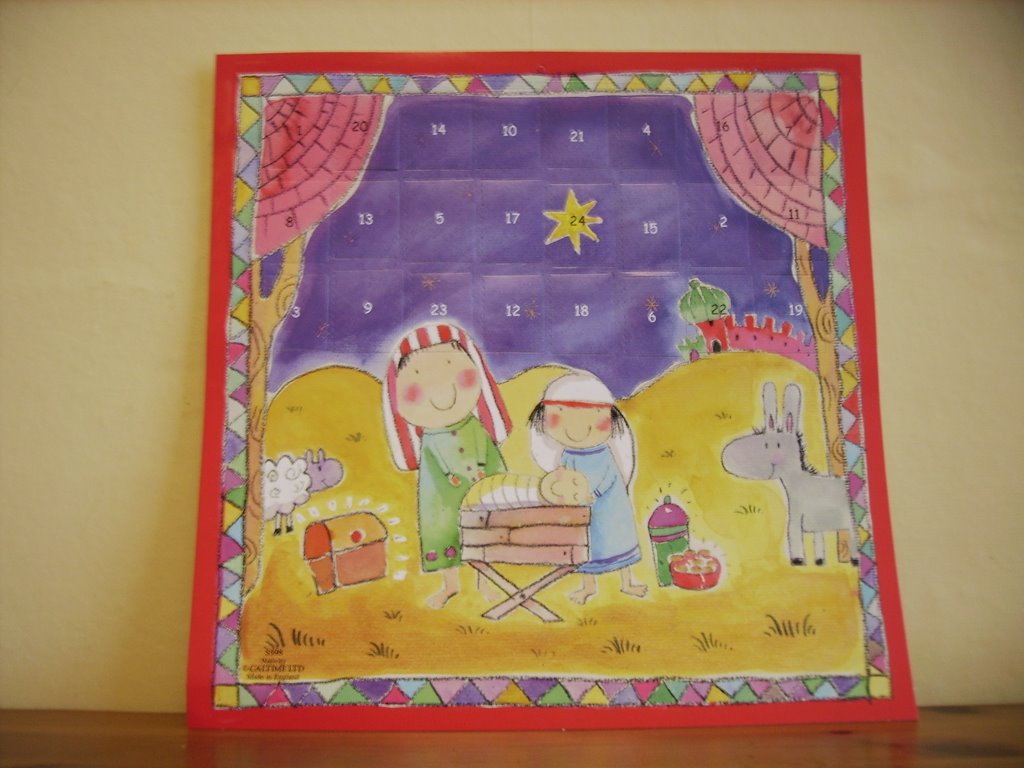
Advent Calendar


It's that time of year again! Everyone is counting down to Christmas! In our house we have a traditional picture calendar, not a chocolate in sight I'm afraid! It's rather unsophisticated - in this age of edible advent calendars, electronic advent calendars, and so on.

I like the picture on the front of our calendar. There is a manger under an open sky. Mary and Joseph are alone with the baby. The first Christmas was an unsophisticated affair. And yet, behind the simplicity of the event, what an amazing spiritual significance. Immanuel - God is with us!

Tuesday, November 14, 2006

Christmas is Coming


Angels are dancing in Albert Square, central Manchester ... the Christmas lights are on. This year the square hosts a traditional Christmas tree surrounded by three angels with trumpets. How faithful to the original Christmas story! Angels announced Christ's birth to Mary and Joseph before the event, and to the shepherds immediately afterwards.

There are two problems though. First the angels are surrounded by a metal ring-fence, so one has to appreciate them from a distance. Second, the whole of Albert Square is swamped by a Christmas market, which quite diminishes the effect of the festive decorations.

This is representative of modern society's approach to Christmas. If we are to appreciate the true meaning of Christmas at all, then we only do so remotely, from quite a distance. Get close to Christmas this year! Think about the historical narrative in the Gospel records. Think about the apostolic interpretation in the Epistles.

Then again, don't let your Christmas be overcome by rampant consumerism. The Christmas Spirit isn't shopping! Recall the baby born in obscurity - heaven's riches exchanged for earth's poverty. (2 Cor 8v9).

Thursday, October 19, 2006

Prayer Challenge


Have you seen the Special K challenge? It involves eating cereal for two weeks, with guaranteed improvements to your waistline! Well, I'm suggesting a prayer challenge with guaranteed improvements in your spiritual experience! I started yesterday, I'll let you know what happens in two weeks. Why don't you start now? Here's how it works. Decide on a suitable time of day and place. Then spend 10 minutes every day for the next two weeks talking to God. Try to go to the same place at the same time, each day. Who knows what the results will be?

There are plenty of Bible examples of people who had regular prayer-conversations with God. And they had amazing experiences! If you follow this through, it's guaranteed that something similar will happen to you! Think about Lydia, down by the river in Philippi. She found God (or God found her) for the first time properly. Daniel discovered old enemies (fellow courtiers) and new friends (hungry lions) in the palace at Babylon. Nehemiah got extended leave for a massive holiday DIY project. Elijah ran the weather forecasting industry out of business.

Finally, what about Jesus? His prayer life led to self-sacrifice on the cross. When he said to His Father - "Not what I want, but what you want. Let that happen" - he knew it would mean going all the way and giving his life. But he was prepared to go anywhere, do anything for God. Even to Calvary!

Wednesday, September 27, 2006

No timetable for departure (or arrival!)


Tony Blair repeatedly fails to clarify his departure plans. Everyone knows he is on his way out, but no-one is quite sure when, least of all himself it seems. His colleagues excuse this behaviour as necessary to safeguard his political legacy. On the other hand, his critics suggest that he is attempting to cling to power for as long as it takes to undermine his most likely successor.

The Bible promises that Jesus Christ will return one day, but "no-one knows the time, or the day, when the Son of Man will return. Not even the angels know it. It is the Father's secret." (Mark 13.32) He will come to establish himself as supreme world ruler. His government will be fair (Isaiah 32.1), firm (Rev 12.5) and for ever (Dan 2.44). What a marked contrast to present governments which seem so corrupt, weak and temporary!

So why are we waiting for His return? The Bible explains that God is still patiently waiting for people to turn to Christ. The remarkable truth is that if we submit to His rule now, then we will share in His rule in that coming Kingdom. (2 Tim 2.12)

Monday, August 28, 2006

Cross Character


A man's attitude as he approaches death ought to be a cameo of his life's character. Consider the impetuous cry of Horatio Nelson, the unstinting commitment of Robert Scott, the optimistic vision of Martin Luther King, and so on.

Now think about the attitude of Jesus of Nazareth as he hung upon a Roman cross. John 19:25-27 provide a good summary.

Standing by the cross of Jesus were his mother; his mother's sister; Mary Cleophas and Mary Magdalene. Seeing his mother and his beloved disciple [John], Jesus said to his mother, "Madam, look, this is your son." Then he addressed his disciple, "Look, this is your mother." So from then on, that disciple accepted her into his own family.

Three great virtues of the Lord Jesus Christ were also displayed in his followers at the cross.

  1. devotion
  2. care
  3. obedience


Devotion

If the Son of God had not been devoted to his Father, then he would never have gone to the cross. But his unquestioning devotion had brought him to Calvary, and would take him through Calvary.

Some of his closest acquaintances were so devoted to him that they followed him to Calvary and stood by him, even in that place. At Calvary, it was not only shameful to be associated with Jesus of Nazareth, it was also dangerous. How little stigma is attached to his Company in 21st century western society!

Care

If the Son of God had not cared for us, then he would never have gone to the cross. But because he loved a world of helpless and hopeless humans, he died so that we could have our sins forgiven through faith in him.

It is clear from his words that he expects his followers to show the same self-denying care - first to one another ("This is how all men will know you are my followers, when you love one another" was his advice) and then to the world at large ("love your enemies" was his most stark and difficult command).

Obedience

"He became obedient to the point of death, and that a cross death." Marvel at the extent of his obedience to God the Father! Without that obedience, we would never be able to pay the price for our disobedience to God. But the Bible clearly teaches that his obedience more than compensates for our disobedience, (as ever, with the "by faith" disclaimer!).

His clear expectation on the cross was that his followers would carry out his dying requests in loving obedience to him. His commands still stand today. And obedience is still expected. The first command "You must be born again!" is prerequisite to all others ... faith is fundamental to following Him. With that foundation, we can exhibit devotion to duty, care for others, obedience to God - just like Him.

Tuesday, August 15, 2006

Mindless Violence


Last Friday night, my friend and I became the victims of mindless violence. A Liverpool youth accosted us, accused us of insulting him and promptly hit us both, hard. Without explanation, indeed, without reason. Causeless, mindless violence.

Over the last few days I have been thinking about our experience. It helped me to imagine a little about how the Lord Jesus must have suffered, as he faced "such contradiction of sinners against himself". They "did not know what they were doing" as they mocked him, battered him and utterly abused him. Was this just mindless violence? In one way - yes - since the perpetrators had no thought about the significance of their actions. However in another way - no - since the victim knew exactly what was coming his way - before as well as during the horrific events of his Passion. He was fully aware of all that "the Father had given him to do" - and fully ready to accomplish it. He never acted mindlessly. He "humbled himself and became obedient to the point of death, and that a cross death". Why? He did it for me!

"He was wounded for my disobedience
bruised for my immorality
He took the punishment to bring me peace
And because of his beating, I am healed"

Thank you Lord! Once a victim, now the Victor!

Thursday, August 03, 2006

A Peace-Loving Israeli


The concept of shalom permeates Jewish society. From a casual greeting "shalom!" to a title of Divinity "SHALOM" (Judges 6.24) the word is often on their lips. Shalom means peace, the state of rest, well-being, completeness and prosperity (according to W.E. Vine).

This shalom sentiment seems a far cry from the current actions of the state of Israel as portrayed in the Western media (bbc, cnn). But let's think for a while about one Jew whose every word and action epitomized perfect shalom.

He said things like this:
  • "Let tired and troubled people come to me and I'll give you shalom" (Matthew 11.28)
  • "I bequeath shalom to you, my shalom I give to you freely" (John 14.27)

He did things like this:
  • Bring immediate shalom to nature, on a stormy night at sea. (Mark 4.35-39)
  • Grant lasting shalom to people, afraid and doubtful as they were (John 20.19-23)

The greatest shalom He offers is in our relationship with God. Naturally we are estranged from God, alienated by our sinfulness. He can provide us with forgiveness, reconciliation and shalom. How? Because he
"made shalom by the blood of His cross." (Colossians 1.20)

In His death, He suffered all the trials, troubles and torments so that we can come to know and enjoy the perfect shalom of God in our hearts. The angel song of "Shalom on earth, good-will to men" can become a reality to us when we accept Jesus as Messiah, Saviour, and Lord in our lives.